
Monday, 27 June 2016

Uses and Gratifications Theory
Personal Identification - when I get angry for whatever reason or if I am feeling something really deeply certain music replicates that feeling, replicates me.
Information - sometimes you learn something from a song? VANT's music, for example Birth Certificate teaches me about the establishment, the tyranny of patriotism etc
Entertainment - Bruno Mars and his dance moves.
Social Interaction - songs my friends and I would always request and dance to when we went out, all our house music that we love together.
Escapism/distraction - Music takes you away from that current moment or helps you deal with it.
Create mood - romance, melancholy, upbeat.
Cheer you up - makes you happier to listen to great music.
Add atmosphere to a gathering - takes away tension in the air filling it with sound waves.
Help you sleep - slow music can relax you and send you to sleep.
Companionship - driving, travelling is helped by a good album of music or playlist.
Cheer you up - makes you happier to listen to great music.
Add atmosphere to a gathering - takes away tension in the air filling it with sound waves.
Help you sleep - slow music can relax you and send you to sleep.
Companionship - driving, travelling is helped by a good album of music or playlist.
Audience
How do i consume music?
I mostly listen to all my music on spotify through my phone or on my computer but i do still buy albums if i really like the band and want to support them for example i recently bought Tom Odells new album Wrong Crowd and listened to it on my itunes or ipod.
I wake up to music as my alarm and listen to music all through the day apart from in lessons. In the morning i listen to music that is easier to sing to and wake me up but then towards the evening i go for more slow music like Foals, the indie slow rock with the trancey guitar solos are a great chill out listen for the night time.
The only time i really share music is if someone is around, like when friends are round we stick on some bangers, its a communal thing, they choose a song, i choose a song. Or it can be more than one person like in the morning after a party and we are all hanging laying on the floor listening to Frank Ocean (its just a thing) just absorbed in the void that is our experience of the world around at that current time - "the morning after the night before". With that it is like a communal thing again you put on different songs that fit the mood set up by the first song.
Music for me is a distraction or an acceptance of the way I am feeling in that moment. I put music on when i go in the shower or am trying to work to just have something that is good in the background distracting me from the fact that i am doing work (literally right now as i write this i am listening to The XX). Or it can be an acceptance of how you want to feel, not necessarily sad.
I mostly listen to all my music on spotify through my phone or on my computer but i do still buy albums if i really like the band and want to support them for example i recently bought Tom Odells new album Wrong Crowd and listened to it on my itunes or ipod.
I wake up to music as my alarm and listen to music all through the day apart from in lessons. In the morning i listen to music that is easier to sing to and wake me up but then towards the evening i go for more slow music like Foals, the indie slow rock with the trancey guitar solos are a great chill out listen for the night time.
The only time i really share music is if someone is around, like when friends are round we stick on some bangers, its a communal thing, they choose a song, i choose a song. Or it can be more than one person like in the morning after a party and we are all hanging laying on the floor listening to Frank Ocean (its just a thing) just absorbed in the void that is our experience of the world around at that current time - "the morning after the night before". With that it is like a communal thing again you put on different songs that fit the mood set up by the first song.
Music for me is a distraction or an acceptance of the way I am feeling in that moment. I put music on when i go in the shower or am trying to work to just have something that is good in the background distracting me from the fact that i am doing work (literally right now as i write this i am listening to The XX). Or it can be an acceptance of how you want to feel, not necessarily sad.
No Rest - Dry the River
We listened to the song No Rest by the band Dry the River, we had to listen to the song first with our eyes closed and really feel and think about the song and what we visualise, then we read along the lyrics and finally we watched the music video for the song.
Emotions?
From the song i get emotions like a happy sadness from the mythical-esk lyrics at the beginning, speaking about kings and names of legend like "Soloman". These emotions were rectified in the lyrics used in connection to the story they tell, in my opinion, a build up of a one sided relationship and then the break down. The video conjures the same emotions as this but there is more added to it because of the interpretation of the visual imagery like the visual metaphors that the band use to represent certain parts of the relationship. Making the connections of visual metaphors in conjunction to the story then emits a deeper level of emotion for the watcher.
Visualisation and Music Video Imagining
A lone man walking through the corridors of a castle then finding happiness in some way or another, a woman, a teddy bear (more of an abstract idea, like a childlike connection to something), etc.
Love and heartbreak, running around in summer my holiday to the Czech Republic, sunlight and slow motion stuff in meadows and fields. running around with his new love and then being alone again wandering the halls of the castle but life is okay now even though he is alone.
In the video i imagine has no performance from the band instead just the narrative of the lone man, haunted by his loneliness and then finding his happiness but then it turns to sadness again; i got this idea from the echoed high voices of the singers and the filling music of the instrument very emotive music.
The music video
The music video was not what i visualised but i can see how it shows the journey of the song, being alone "like Soloman", then not being alone exemplified by the rocks surrounding them, the fire showing the passion of the love but then the dead bird being a omen of the heartbreak or breakdown of the relationship, then the water being chucked over the band - rather aggressively - shows the trauma of those emotions being broken and running away, as portrayed in the second last verses lyrics and then for the last verse the enlightenment from the experience is portryed through the bright light on the bandmates faces.
Other Peoples Ideas
Ben G - "In my head I saw a lone man walking along a beach, and it would cut to him seeing his wife/girlfriend, creating a feel that they have split up and he misses her."
Bens idea follows the same sort of theme as I had and that the song has, that of heartbreak and relationship, we saw different settings of the video in our minds, different from each other an different to the actual music video.
We both shared the image of seeing a lone man walking around, alone. And the idea of a loved one being gone.
The Video
Emotions?
From the song i get emotions like a happy sadness from the mythical-esk lyrics at the beginning, speaking about kings and names of legend like "Soloman". These emotions were rectified in the lyrics used in connection to the story they tell, in my opinion, a build up of a one sided relationship and then the break down. The video conjures the same emotions as this but there is more added to it because of the interpretation of the visual imagery like the visual metaphors that the band use to represent certain parts of the relationship. Making the connections of visual metaphors in conjunction to the story then emits a deeper level of emotion for the watcher.
Visualisation and Music Video Imagining
A lone man walking through the corridors of a castle then finding happiness in some way or another, a woman, a teddy bear (more of an abstract idea, like a childlike connection to something), etc.
Love and heartbreak, running around in summer my holiday to the Czech Republic, sunlight and slow motion stuff in meadows and fields. running around with his new love and then being alone again wandering the halls of the castle but life is okay now even though he is alone.
In the video i imagine has no performance from the band instead just the narrative of the lone man, haunted by his loneliness and then finding his happiness but then it turns to sadness again; i got this idea from the echoed high voices of the singers and the filling music of the instrument very emotive music.
The music video
The music video was not what i visualised but i can see how it shows the journey of the song, being alone "like Soloman", then not being alone exemplified by the rocks surrounding them, the fire showing the passion of the love but then the dead bird being a omen of the heartbreak or breakdown of the relationship, then the water being chucked over the band - rather aggressively - shows the trauma of those emotions being broken and running away, as portrayed in the second last verses lyrics and then for the last verse the enlightenment from the experience is portryed through the bright light on the bandmates faces.
Other Peoples Ideas
Ben G - "In my head I saw a lone man walking along a beach, and it would cut to him seeing his wife/girlfriend, creating a feel that they have split up and he misses her."
Bens idea follows the same sort of theme as I had and that the song has, that of heartbreak and relationship, we saw different settings of the video in our minds, different from each other an different to the actual music video.
We both shared the image of seeing a lone man walking around, alone. And the idea of a loved one being gone.
The Video
Representation
Voyeurism - (Freud) erotic pleasure can be gained by looking at a sexual object (preferably when the object is unaware of being watched).
Male gaze - Laura Mulvey 1975 proposed that because filmmakers are predominantly male the presence of women is often for the purposes of display (rather than narrative).
Exhibitionism - Female performers being at once sexually provocative and apparently in control of and inviting a sexualised gaze in what could be termed as the opposite of voyeurism.
Raunch Culture - Andrea Levy (from her book Female Chaivnist Pigs) makes the argument of raunch culture where women are made to see themselves as objects and see sex as their only source of power.
Female Gaze - a Gaze trope, work is presented as from a female perspective or reflects female attitudes, either because of the creator's gender or because it is deliberately aimed at a female audience
Homosexuality - Although lesbian, gay, bisexual and transgender individuals are generally indistinguishable from their straight or cisgender counterparts, media depictions of LGBT individuals often represent them as visibly and behaviorally different.
Strong dominant female - being everything a male stereotype is.
Examples of Female Gaze and homosexuality in music video industry:::
Homosexuality :
Do you think there is an imbalance in the representation?
Yes completely, the female gaze is seen a little less than the male gaze of women and gay relationships are definitely very very rare in the industry. The honest answer is the majority of people in the world that consume this media type (music videos) would much rather look at "fit" woman who are cladly dressed than look at two gay men kissing but there is the argument of lipstick lesbians in the media that would be widely consumed because of it glamorisation of homosexuality.
Sunday, 26 June 2016
Friday, 24 June 2016

Tuesday, 21 June 2016
Carol Vernallis - Theories for Music Videos
Narrative is a free thing in music videos, it is not controlled or tame. In a music video there can be a story or there cannot be - but there is still a narrative being portrayed. The story can be fragmented, the whole story is not needed; it can be the beginning, the middle or the end. Just a snapshot provides a narrative.
This narrative theorie can be seen in David Bowies Video for Lazarus - it is unknown where it stems from but there is story there and it is a free thing :::
Editing, unlike in a film, continuity editing does not matter, the rules of editing in a film do not stand in a music video. E.g you can break the 180 degree rule.
The breaking of the continuity editing 180 degree rule is seen in Sia's video for the song Elastic Heart :::
Camera Movements and framing are key features to a music video. There are certain shots that just have to happen, an establishing shot, master shots, close ups. Camera can be used to change the pace.
Classic camera movements and framing that "just have to happen" can be seen in the video for Tom Odell's Wrong Crowd.
Diegesis - creating a world within the music video. That world can be realistic (like the one we live in) or unrealistic (a fantasy place).
A fantasy world is most definitely created and exemplifies the Diegesis theory in the music video for Radioactive by Imagine Dragons.
Monday, 20 June 2016
Goodwins Theories of Music Videos
Goodwins Theories
- Illustrate or amplify or contradict the lyrics and visuals in a music video.
- Thought Beat - seeing the sounds of the music, i.e visuals and the music are in sync like cuts in the video to the drum beat.
- Genre-Related Style and iconography - basically the mise en scene of the video, repetitious looks of the band, the 1975 have their iconic pink neon lights.
- Multiple Close UP of the main artist or vocalist : the creation of a star-image to promote recognizable image.
- Voyeurism - sexualising the artist to entice the audience, seen with boyband and some female acts like JLS and Kylie. Always showing off their bodies.
- Intertextual References to other media texts - references to films or shows, other media texts, engaging the audience because the audience will recognize something and feel like they are a part of the video by having an "understanding".
Wednesday, 15 June 2016
Examples of Music Videos
Heavy Metal, Pop and hip hop
Example of a classic heavy metal music video - it shows only the performance aspect of music video conventions.
Example of a Pop video - again showing mostly performance but in a more entertaining way, not just a band playing there is a series of different scenes of dancing and such things also the video itself is bright and colourful.
Example of hip hop ::::
Showing the performance of the artist but also the context that the music comes from.
Example of hip hop ::::
Showing the performance of the artist but also the context that the music comes from.
Forms and Conventions
Music videos commonly have :
- Videos performance of a song.
- Dance or a fragmentary story.
- Often use concert footage (sometimes)
- Quick cuts (editing), stylisations, fanciful or erotic imagery.
- Length of video as long as song.
- Can include all styles of filmmaking
A music video is a marketing device, its not a film to watch for enjoyment (it is but it isn't in some cases) it is actually an ad for the band, albums and that specific song.
Music Videos will often follow one or more of these things:
- Performance
- Narrative
- Concept
Performance - like a dance along to the music being shown or a concert (real or created just for the video)
Narrative - Showing a story of some kind.
Concept - showing idea of some kind, a challenging idea or just trying to portray something.
30 Second Breakdown
0-6 : The Lumineers Ophelia title screen in the centre of black, fades to black.

6-14 : Fade out of black to a midshot of the band, lights build in intensity with footstomps till singing begins, camera zooms into the lead singer has he walks to the mic, lights turn blue.
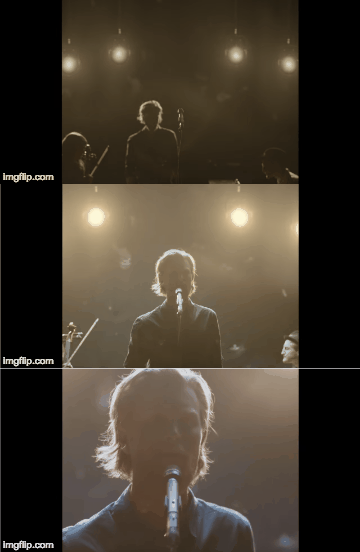

17-21 : Cut, shot change to close up on other band mate, tracking around person to the left.

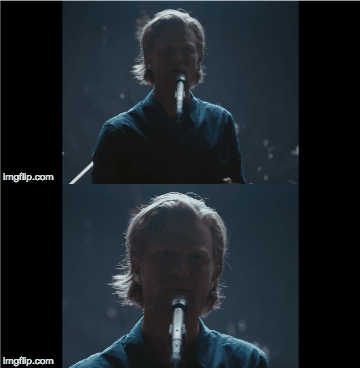
21-24 : Cuts back to lead, tracking to the right, close up of head, slight low angle tilted up.

24-26 : Cut to high angle tilt down of piano hands playing to the music, over the shoulder shot.

26-29 : Mid Shot of lead, tracking to the right, now behind the band - facing the bands backs.

29-30 : Cuts to the front of the artist, low angle tilt up, zooms from mishit to close up of face.
Tuesday, 14 June 2016
What Music Means to Me

So first the hazy "Early Memories" I remember distinctly Jungle Book's Bare Necessities being played in the evening and dancing with my mum, I suppose its quite a normal childish thing to listen with Disney films being a prominent feature to a childs life. Then strangely I remember Elvis Presley, I really had a thing for those Blue Suede Shoes, I don't know why - I no longer listen to this music. Ever. And lastly I remember Madness because my brother would always be singing it, so naturally I latched onto the music as well trying to be like my big bro (cringe) belting out the lyrics to Baggy Trousers and Our House.
It is nice to have the songs of my early childhood be happy and dance'y songs, I guess my flaws do not come from that time period if the music taste was so good but it does show that my taste is heavily under the influence of what's around me (apart from the random Elvis song). Disney films and my brother.
Next the Short trousers, long socks, cap, blazer, book bag time of my life - "Primary School". In this part of my life I found the internet, made more sticking friends and I feel, looking back, more aware of my music tastes. Mika, a very solid choice by me (if I do say so myself) and the song that sticks out is Lollipop; these songs again were happy songs, fun childish songs - I think it was a hit song on Heart FM (Essex FM at the time) so I heard it a lot on the radio to school and back, liked it and then got the album. And I think in this time I was listening to collection albums like Pop Party and NOW *insert number*. And a song that sticks out again in my mind is Mr Blue Sky by The Electric Light Orchestra i think it was just a song that my mum or brother started listening to, i don't know how i would have found it otherwise. And then the largest regret of my life! I'm just over-exaggerating for effect but still Nickleback, it was something me and my friend liked to listen to American rock i dunno its a sad memory but i liked that music at the time and the music videos were good on you tube for my young naive eyes.
First Few Years of secondary school i was developing more of my own taste but still listening to what was popular at the same time (in terms of example and the EDM stuff) but the question begs to be asked can you listen to popular music and say it was totally your own finding and that it is completely your taste? I think not because i no longer listen to that music now and i know tastes change but i have listened to the same-ish music for the last 2-3years so i must say that my tastes are clearly defined and back then i was just jumping in with what was popular and what i actually liked. I suppose i listened to the popular music because radio 1 came into my life and you are surrounding by people at school who all listen to the same music, whatever is top in the charts was cool and every kid wants to be cool so you all do the same thing (i am generalizing here, obviously some people are a bit more individual than others back then, identity takes time to build, so not everyone was overly obseessed with being the "cool" kid). This age of exploration of ones own tastes is shown through the example period, example was big with a few hits but i bought all three albums in those few years - music that i would never listen to now but at the time it was a major part of my iTunes library.
Now in the last 2 to 3 years i have truly found what i love and what i would define as my tastes in music. This is mostly through becoming more on an independent, introverted individual and spending more time online and the access to Spotify on my computer helping me explore tastes and genres of music. Nathaniel Rateliff, in his solo career of music and with his band now is a major part of my music taste and very different to anything else on the table. His solo stuff is really depressing country guitar stuff, the lyrics and the music is relaxing to me when i am in the mood for that genre but then if i want a bit more of a get up kinda vibe i listen to his band Nathaniel Rateliff & the Night Sweats which is blue and soul music, that is great for singing out looud to and the whole composition of that genre is just nice for the ears - this music (and everything else from this time) is just really relatable for me now, singing about drinking, partying, sex, girls, drugs etc all those kind of things. I thinks that a main thing with all thses artists, Catfish, Tom Odell, Mumford and Sons, Ben Howard i just relate to that music, the music helps me and even though some of the names are well known i feel like not everyone listens to them so it is more for me.
In conclusion, to address the title directly. Music, is a very powerful and personal thing and also really influential for me. Music can bring back the saddest memories, evoke strong emotional response from me happy or sad or it can just be something to get me hyped. It has carried me through my whole life in the background. Music simply is one of the best things in the world.
Terminology
Homogenous Group: A group that all have the same characteristics
Mediation: The selection and construction of material in how it is given over to audiences via editing and point of view
Hegemony: Traditional stereotypes that are reinforced and circulated as common sense to audiences
Marginisalisation: How stereotyping can lead to someone or a social group being ‘placed’ on the outside of accepted cultural norms
Ideology: An overarching set of ideas often uses as a form of social control
Moral Panics: Issues in society that often lead to the blaming, and marginalisation of a scapegoat
Deviancy Amplification: Associated with moral panics, this explains how the media exaggerate a negative representation to ensure a dominant shared reading
Liberalisation: A more diverse, tolerant, equally acceptable approach
Pluralism: Again, more liberal suggesting and range of different, challenging representations
Web 2.0: Interactive internet media e.g. blogs and social networking
Manifest: Obvious, on the surface meaning
Cultural Stereotyping: The stereotyping of social groups in society by the media
Prosumer: A producer and consumer of media
Passive Audiences: Audiences that accept and do not challenge representations
Iconic: Well known and respected
Aspiration: Looking up to something or somebody
Encoding/Decoding: Putting meaning in, taking meaning out
Dominant, Negotiated and Oppositional Readings: The intended meaning of a text, where meaning is uncertain or where audience have decoded a completely different reading
Anchorage: How meaning is made more definite
Binary Oppositions: Where representations are deliberately different to construct further meaning
Latent Meaning: Less obvious meaning
Memes: Internet ‘stars’
Mediation: The selection and construction of material in how it is given over to audiences via editing and point of view
Hegemony: Traditional stereotypes that are reinforced and circulated as common sense to audiences
Marginisalisation: How stereotyping can lead to someone or a social group being ‘placed’ on the outside of accepted cultural norms
Ideology: An overarching set of ideas often uses as a form of social control
Moral Panics: Issues in society that often lead to the blaming, and marginalisation of a scapegoat
Deviancy Amplification: Associated with moral panics, this explains how the media exaggerate a negative representation to ensure a dominant shared reading
Liberalisation: A more diverse, tolerant, equally acceptable approach
Pluralism: Again, more liberal suggesting and range of different, challenging representations
Web 2.0: Interactive internet media e.g. blogs and social networking
Manifest: Obvious, on the surface meaning
Cultural Stereotyping: The stereotyping of social groups in society by the media
Prosumer: A producer and consumer of media
Passive Audiences: Audiences that accept and do not challenge representations
Iconic: Well known and respected
Aspiration: Looking up to something or somebody
Encoding/Decoding: Putting meaning in, taking meaning out
Dominant, Negotiated and Oppositional Readings: The intended meaning of a text, where meaning is uncertain or where audience have decoded a completely different reading
Anchorage: How meaning is made more definite
Binary Oppositions: Where representations are deliberately different to construct further meaning
Latent Meaning: Less obvious meaning
Memes: Internet ‘stars’
Subscribe to:
Comments (Atom)